Speak to a licensed insurance agent.
1-888-411-7647 | TTY:711
Mon. - Fri. 7:30 am - 5 pm CT
SmartMatch Insurance Agency Logo

Decoding Benefits: OTC Benefits vs. Grocery Allowances in Medicare Advantage

Medicare Advantage plans offer a variety of supplemental benefits, which can sometimes lead to confusion. Two benefits that are frequently compared are Over-the-Counter (OTC) benefits vs. grocery allowances. While both aim to support members’ well-being, they serve different purposes and have key distinctions.

OTC benefits recap

As we’ve discussed in Part I, OTC benefits provide an allowance for purchasing health-related over-the-counter products. These benefits are designed to help members manage their health and wellness by providing access to items like pain relievers, cold and flu remedies, and first-aid supplies. OTC benefits are a common feature in many Medicare Advantage plans. 

Grocery allowances explained

Grocery allowances, also called the health foods benefit, are a different type of benefit with a more specific focus. These stipends are typically offered through Special Needs Plans (SNPs). SNPs are a type of Medicare Advantage plan designed to serve individuals with specific needs, such as:

  • Chronic conditions (e.g., diabetes, heart disease)
  • Institutionalization (e.g., living in a nursing home)
  • Dual eligibility (eligible for both Medicare and Medicaid)

Grocery allowances aim to address food insecurity and promote healthy eating among these vulnerable populations. They provide an allowance that can be used to purchase eligible food items, such as:

  • Fruits and vegetables
  • Lean meats and poultry
  • Dairy products
  • Other nutritious foods

The specific food items allowed will vary by plan, but the focus is generally on providing access to healthy and essential food choices.

How does the Medicare grocery allowance work?

How a Medicare grocery allowance works depends on your insurance carrier and plan. In many cases, D-SNPs provide flex spending cards that you can use like a debit card. These cards are typically preloaded on a monthly or quarterly basis.
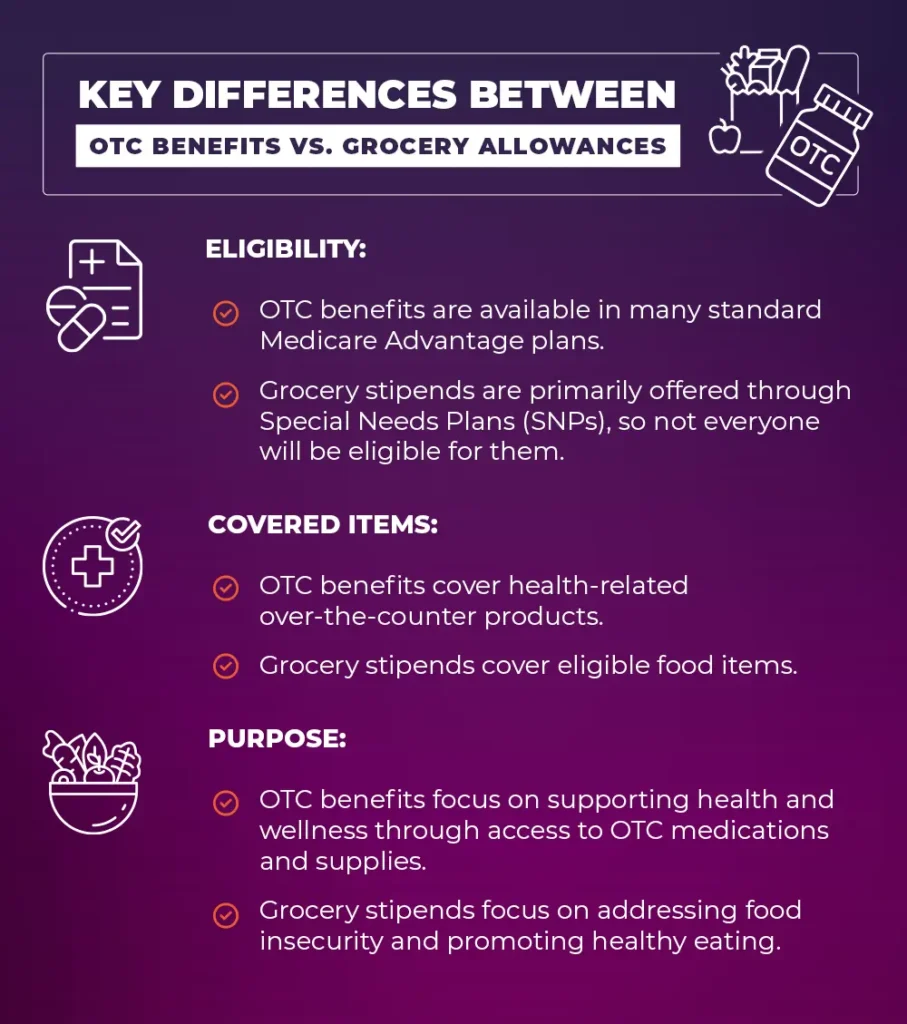
Here's a breakdown of the key differences between OTC benefits and grocery stipends:

Eligibility: OTC benefits are available in many standard Medicare Advantage plans, while grocery stipends are primarily offered through Special Needs Plans (SNPs). This means that not everyone will be eligible for grocery stipends.  

Covered Items: OTC benefits cover health-related over-the-counter products, while grocery stipends cover eligible food items.

Purpose: OTC benefits focus on supporting health and wellness through access to OTC medications and supplies, while grocery stipends focus on addressing food insecurity and promoting healthy eating.

Key distinctions between OTC benefits vs. grocery allowances

Here’s a breakdown of the key differences between OTC benefits and grocery stipends:

  • Eligibility: OTC benefits are available in many standard Medicare Advantage plans, while grocery stipends are primarily offered through Special Needs Plans (SNPs). This means that not everyone will be eligible for grocery stipends.  
  • Covered Items: OTC benefits cover health-related over-the-counter products, while grocery stipends cover eligible food items.
  • Purpose: OTC benefits focus on supporting health and wellness through access to OTC medications and supplies, while grocery stipends focus on addressing food insecurity and promoting healthy eating.

It’s important to understand these distinctions when evaluating Medicare Advantage plans. If you have specific needs related to food insecurity and a qualifying condition, a Special Needs Plan with grocery stipends might be a valuable option. If you’re looking for assistance with everyday health and wellness expenses, a Medicare Advantage plan with OTC benefits could be a good fit.


*Disclaimer:

The information provided in this blog post is intended for general informational purposes only and does not constitute medical advice. It is not a substitute for professional medical consultation or treatment. Always consult with a qualified healthcare provider for any questions you may have regarding a medical condition.

SmartMatch does not endorse or recommend any specific products, treatments, or procedures mentioned in this article. Reliance on any information provided in this blog post is solely at your own risk. We encourage you to discuss any health concerns or questions with your doctor before making any decisions about your health or treatment.

Share This Article:

Blog Categories

Ready to get SmartMatched?
Get no-obligation Medicare guidance and support today.
M-F, 7:30 AM - 5 PM CT
Ready to get SmartMatched?
Get no-obligation Medicare guidance and support today.
M-F, 7:30 AM - 5 PM CT
SmartMatch Insurance Agency, LLC
Corporate Office:
120 W. 12th St.
Suite 1700
Kansas City, Missouri 64105

Business Hours:
Monday – Friday
7:30am – 5pm CT
Stay Connected
To learn the number of organizations and number of products we represent in your area, enter your ZIP code after clicking the button below.

Which type of Medicare insurance is right for me?

Find your personalized Medicare recommendation in just 2 minutes

Question 1 of 10

Your Health
Healthcare Usage
Looking Ahead

(Surgery, treatment, new diagnosis, etc.)

Provider Preferences
Cost Considerations

Lower monthly premiums may mean you'll pay more when you need care; higher premiums may mean you'll pay less for care.

Extra Benefits
Prescription Drugs
Plan Simplicity

More cards (policies) may mean more flexibility with coverage; fewer cards provides simplicity but less flexibility.

Current Coverage

*Submitting your information will save your responses anonymously in order to verify the accuracy of our recommendation engine. Again, no personal information is saved.

Please log in to view assigned tenants.