

As you approach the age of 65 while still working, you may be considering the benefits of Medicare compared to your employer’s group health coverage. One of the most common questions we get from customers is, “How does Medicare affect HSAs?”. We’ll outline what the different parts of Medicare mean for Health Savings Account contributions, and how to weigh the decision between enrolling in Medicare while working.
An HSA is a tax-advantaged savings account designed to help individuals with high-deductible health plans (HDHPs) save for medical expenses. Contributions made to an HSA are tax-deductible, earnings grow tax-free, and withdrawals used for qualified medical expenses are also tax-free.
You can think of this as a special savings account just for medical expenses. These qualified expenses include things like doctor visits, prescriptions, and even some dental and vision care. Because HSAs are only available with high-deductible health insurance plans, it means you’ll pay more out of pocket before your insurance kicks in.
Medicare Part A (Hospital Insurance) is considered “disqualifying coverage” for HSA purposes. Per IRS regulations, once you are enrolled in any part of Medicare, you can no longer contribute to an HSA.
However, Medicare enrollment can be different depending on whether you are actively working or you are already withdrawing Social Security benefits. See the following scenarios below:
If you have already started receiving Social Security benefits, the government will automatically enroll you in Medicare Part A when you turn 65.
If you are 65 or older, still working, and covered by a qualifying High Deductible Health Plan (HDHP), you have more flexibility:
When you enroll in Part A after turning 65, your coverage is backdated up to six months (though never earlier than the month you turned 65). A safe rule of thumb: stop HSA contributions six months before you plan to enroll in Medicare or file for Social Security. If you continue to contribute to your HSA during this time period, you could face tax penalties.
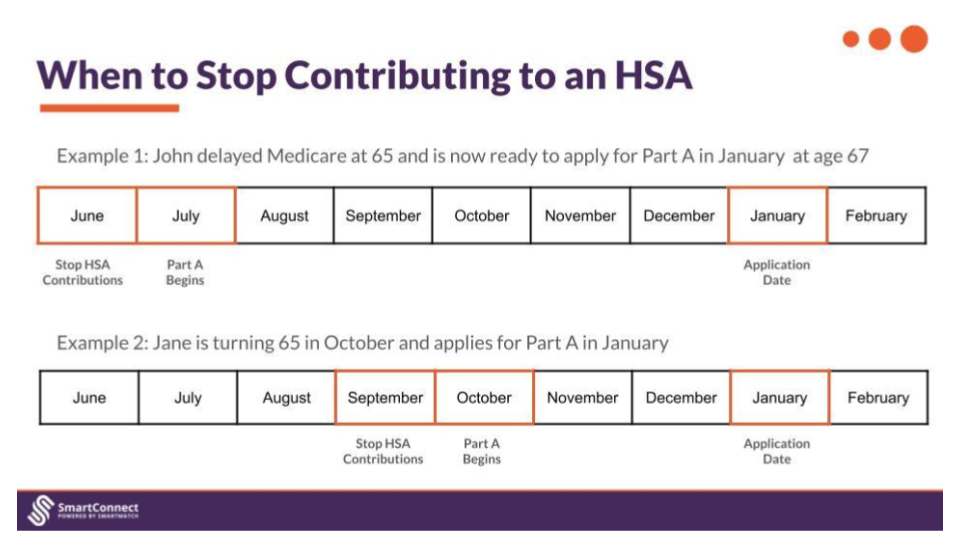
If you wish to continue contributing to your HSA and want to delay your Medicare Part A enrollment, you must meet specific requirements. Firstly, you need to be eligible for Social Security benefits but have not yet filed for them. If you are not drawing out Social Security, you can maintain your HSA eligibility and continue contributing to it until you decide to stop working.
Medicare Part B (Medical Insurance) is optional and covers services such as doctor visits, outpatient care, and medical supplies. However, enrolling in any part of Medicare generally disqualifies you from contributing to a Health Savings Account (HSA). This is because to be eligible for an HSA, you must not have any other health insurance coverage besides a high-deductible health plan (HDHP), and that includes Medicare.
Note: You can’t use HSA funds to pay for Medigap premiums.
Like Medicare Part A and Part B, enrolling in any Medicare prescription drug coverage (Part D) means you are no longer eligible to contribute to your HSA. Medicare Part D is considered creditable prescription drug coverage, which means that having it disqualifies you from contributing to your HSA. However, you can still use your existing HSA funds to cover prescription drug expenses.
Enrolling in Medicare can have implications for your Health Savings Account, depending on the specific Medicare parts you choose to enroll in. It is crucial to carefully consider your options, taking into account your current HSA contributions, employer contributions, and medical coverage needs to make an informed decision that aligns with your financial goals and healthcare requirements.
This is a solicitation for insurance. Not connected with or endorsed by the U.S. government or the federal Medicare program. SmartMatch Insurance Agency and its divisions are licensed to sell insurance products in all 50 states and DC. Callers will be connected with a licensed insurance agent who can enroll you into a Medicare Advantage, Prescription Drug (Part D) and Medicare Supplement insurance plan.
We do not offer every plan available in your area. Currently we represent 9 organizations which offer 3,239 products in your area. Please contact Medicare.gov, 1-800-MEDICARE (24 hours a day/7 days a week), or your local State Health Insurance Program to get information on all of your options. The plans we represent do not discriminate on the basis of race, color, national origin, age, disability, or sex. Not all plans offer all benefits. Benefits may vary by carrier and location. Limitations and exclusions apply. No obligation to enroll. SmartMatch Insurance Agency represents Medicare Advantage HMO, HMO SNP, PPO, PPO SNP, and PDP organizations that have a Medicare contract. Enrollment in any plan depends on contract renewal.
PLEASE NOTE: Medicare Supplement insurance is available to those age 65 and older enrolled in Medicare Parts A and B and, in some states, to those under age 65 eligible for Medicare due to disability or End-Stage Renal Disease (ESRD). Enrollment in a plan may be limited to certain times of the year unless you qualify for a Special Enrollment Period or you are in your Medicare Initial Enrollment Period.
Please log in to view assigned tenants.

