
A plan can sit at the top of a “best Medicare Advantage plan 2027” list and still be the wrong plan for you. Premium and Star Rating are easy to sort. They leave out your doctors, your prescriptions, and the bill you could face in a year when you need a lot of care.
The 2027 plan figures in this article were reviewed October 15, 2026.
Why “best plan” lists can mislead you
Here is what CMS plan data for the 2027 plan year shows about premium and Star Ratings.
- A $0 premium can still leave a large bill. About 2 in 3 standard 2027 Medicare Advantage plans with drug coverage have a $0 monthly premium. Those $0-premium plans have the same typical in-network out-of-pocket maximum as paid plans: about $6,500. About 1 in 5 $0-premium plans has an in-network maximum of $8,000 or more.
- Out-of-pocket maximums vary enormously. For 2027, in-network maximums range from under $200 to $9,850.
- A 5-star plan cannot cover a doctor who is out of network. Star Ratings measure plan quality and service. They do not tell you whether a plan covers your doctors or your drugs.
Source: SmartMatch analysis of CMS plan data for the 2027 plan year, covering 3,196 general-enrollment Medicare Advantage plans with drug coverage. Special Needs Plans are excluded. Reviewed October 15, 2026.
Step 1: Rule out deal-breakers first
Answer these before you compare anything else. A no removes the plan.
- Is the plan available in my ZIP code?
- Are my must-keep doctors and hospitals in network? Check each one, including the hospital, rather than only the group they belong to.
- Are all my prescriptions on the formulary? Note the tier and any restrictions, such as prior authorization, step therapy, or quantity limits.
- Is my pharmacy preferred in-network?
- Do I travel or live part of the year elsewhere? If you do, an HMO may not cover that care. Look at a PPO, or check how the plan treats care outside its service area.
Step 2: Compare what’s left
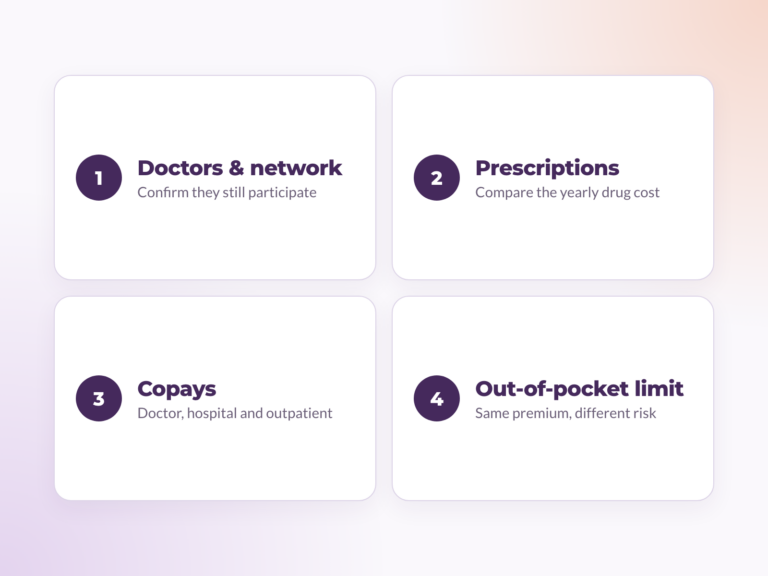
Score each remaining plan in this order. Earlier rows matter more. Give each plan its own column, and stop on a row as soon as it is a deal-breaker.
| Factor | What to check | Weight |
|---|---|---|
| 1. Doctors and hospitals | All in network? Any out-of-network costs? | Deal-breaker |
| 2. Drugs and pharmacy | Estimated annual drug cost at your pharmacy | Deal-breaker / High |
| 3. Expected annual cost | Premium × 12 + estimated copays + drug costs | High |
| 4. Worst-case cost | In-network out-of-pocket maximum. For a PPO, the out-of-network maximum too. | High |
| 5. Plan type and travel | HMO or PPO, and whether you need referrals | Medium |
| 6. Prior authorization | Which services need approval in advance | Medium |
| 7. Extra benefits | Dental, vision, hearing, and OTC allowance: the dollar limit, not only that the benefit exists | Low–Medium |
| 8. Star Rating | Overall quality and member experience | Tiebreaker |
Step 3: Estimate your real annual cost
Expected cost = (monthly premium × 12) + expected copays for your usual care + your annual drug costs.
Worst case = (monthly premium × 12) + the out-of-pocket maximum + your drug costs. Drug costs have their own annual cap, $2100 in 2026, and that cap sits outside the medical out-of-pocket maximum.
If you have ongoing health needs, the worst case tells you more than the premium does.
Step 4: Use Star Ratings as a tiebreaker
Star Ratings run from 1 to 5. They reflect quality, customer service, and member experience, and they help when two plans have already passed the steps above. A high rating cannot repair a network or formulary mismatch.
Ratings differ by plan and by county. Medicare Plan Compare is the official source for plans in your ZIP code.
Compare 2027 plans in your area
Once you know what would rule a plan out, look at what is actually sold where you live.